by IUF Asia/Pacific | Mar 15, 2021 | Women Unions & Power
There is no doubt that the COVID-19 pandemic and crisis has had a much greater impact on women than men. The double burden of family responsibility increased with the closure of schools and Working From Home arrangements. Many women were already in precarious forms of employment when the pandemic started. This quickly turned into excessive working hours or no work at all. Meanwhile the gender pay gap widened, revealing how little real progress was made over the past decade.
Many of the policies of employers and governments to adddress gender discrimination and promote gender equality simply collapsed in the first few months of the pandemic. The systemic vulnerability faced by women due to gender discrimination and patriarchy quicly resurfaced. Despite the call to fight COVID-19 togther, women saw their wages decline relative to men’s wages as the pay gap widened and their work was attributed less value.
At the same time women’s vulnerability to sexual harassment – especially in recruitment and renewal of employment contrracts – increased, as did domestic violence during lockdown.
More than ever women need unions to build their power to fight gender discrimination and inequality and to defend their rights. But to do that unions need to be safe for women and to fight for a safe workplace.
In the week leading up to International Women’s Day (March 8, 2021) our members in 14 affiliated unions in 20 cities in 8 countries held seminars, webinars, real and virtual meetings and public rallies (with masks and distancing) to bring attention to our call for Empowering Women through Unions in the COVID-19 era. They also called for unions to take action to stop sexual harassment and violence against women, and to Make Unions and Workplaces Safe for Women!

by IUF Asia/Pacific | Feb 18, 2021 | Defending Democracy
As the trial of Brother Lee Cheuk Yan, General Secretary of the Hong Kong Confederation of Trade Unions (HKCTU), and eight other democracy activists and human rights defenders began in Hong Kong this week, IUF members throughout the Asia-Pacific protested against this political persecution and expressed their solidarity for the fight for freedom in Hong Kong.

solidarity across the Asia-Pacific region
As the Hong Kong government tries to establish a political regime that is an extension of Beijing, all forms of public accountability and civil governance are being dismantled. But in attempting a politico-legal transition to authoritarian rule, the government violated its own laws, breaching the constitution and the constitutional rights of the Hong Kong people.
As the people reacted to this authoritarian shift with mass protest, the government severely curtailed more rights (freedom of assembly and freedom of expression) to contain public dissent. As the government lost all legitimacy, authorities moved to persecute those accused of organizing the protests. This misses the point: the protests were in response to the government’s attempt to extend the authoritarian reach of Beijing. The government’s actions instigated the protests in August 2019. So it’s the government that should be on trial.
What is also on trial is the Hong Kong government’s international standing. The Hong Kong government has further isolated itself internationally, systematically violating and undermining the principles and standards of the UN system, even as the government in Beijing tries to extend its influence throughout the UN system. The Hong Kong government repeatedly ignored calls by UN human rights experts reporting to the UN Human Rights Council to respect the right to freedom of assembly and freedom of expression.
The UN Special Rapporteur on the right to peaceful assembly and association; the UN Special Rapporteur on the promotion and protection of the right to freedom of opinion and expression; and the UN Special Rapporteur on the situation of human rights defenders called on the Hong Kong government to drop the charges against human democracy activists, rights defenders and trade unionists.
By ignoring this, the Hong Kong government once again demonstrated its hypocrisy. On the one hand desperate to justify itself on the international stage, and on the other claiming this is a local judicial matter (despite authorities and the police violating multiple laws repeatedly). The government also desperately claims that foreign forces are at work in supporting the democracy protests. Yet it is the Hong Kong people reaching out to the world, grabbing hold of internationally recognized universal human rights, and using these rights to protest and speak out that is the basis for their internationalism. And as Brother Lee Cheuk Yan demonstrated on the first day of his trial, by calling for support for the democracy protests in Myanmar, the only force at work in all of this is solidarity.

by IUF Asia/Pacific | Feb 17, 2021 | Campaigns, Our Members
 In the ongoing COVID-19 pandemic the Schreiber Dynamix Dairies Employees Union (SDDEU) in Baramati extended support for contract and casual workers, ensuring free PPE and financial support. Despite the challenges in the pandemic, the SDDEU also continued to negotiate the conversion of casual workers to permanent jobs.

Brother Nanaso Thorat, SDDEU President, presents a permanent appointment letter
On February 11, 2021, 20 casual workers were appointed to permanent positions. This included workers who were casuals for more than 15 years. This is the result of a sustained effort by the union to tackle precarious employment over the past ten years.

by IUF Asia/Pacific | Feb 17, 2021 | Campaigns, Our Members, Sustainable Tourism
While the Nepal tourism industry faces a crisis in the ongoing global pandemic, trade unions in Nepal active in the hotel sector succeeded in defending the jobs and livelihoods of hotel and tourism workers. The active unions, including the IUF-affiliated Nepal Independent Hotel Workers Union [NIHWU], negotiated an agreement with the Hotel Association of Nepal (HAN) to guarantee the job security of hotel workers.
The agreement, which covers a one year period from January 1 to December 31, 2021, guarantees that no hotel workers will be laid off.
 “We secured jobs as our first priority. So even those not working at all will still keep their jobs,” said Surya Bahadur, President NIHWU. “When the lock-down is over and business returns to normal, hotel workers will not need to search for jobs with rising unemployment. They will return to work, which is their right.”
Under the agreement hotel workers will also be paid wages according to a schedule of days worked. Any worker working more than fifteen days in a month will receive the full monthly wage.

by IUF Asia/Pacific | Feb 10, 2021 | Defending Democracy
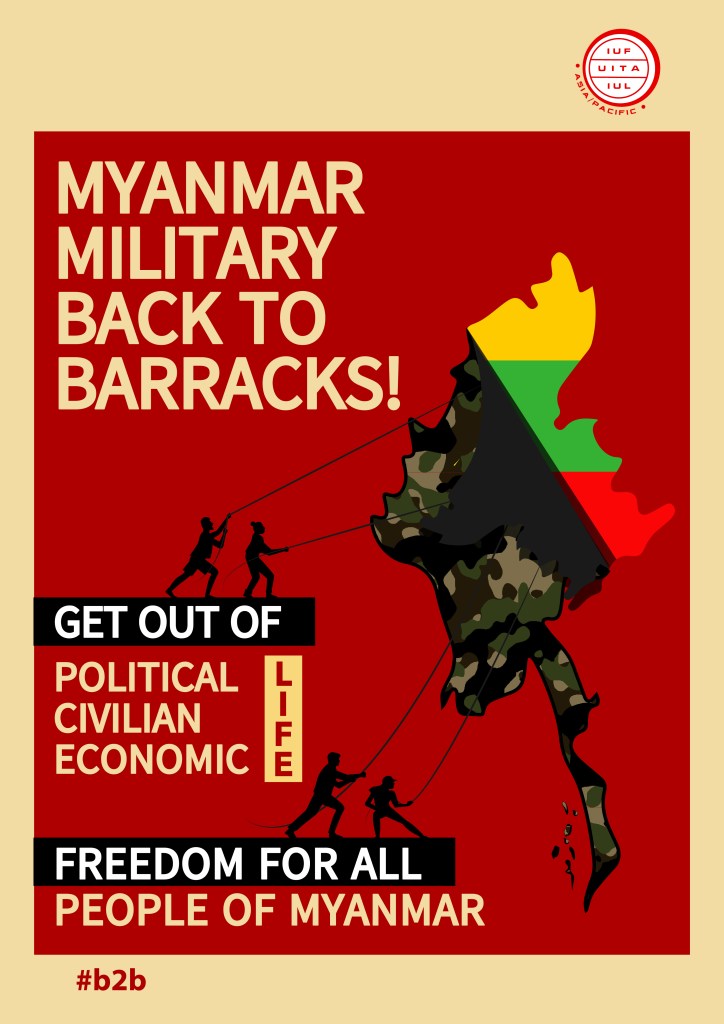
In 2019 the UN Human Rights Council’s Independent International Fact-Finding Mission on Myanmar observed that the impunity of Myanmar’s military is directly linked to its ability to operate independently of any government budget. Through a vast network of military-owned businesses in mining, plantations, sugar mills, beverage manufacturing, transportation, telecommunications, banking, insurance, airlines, hotels and entertainment, the military has its own source of economic power. It also has close business partners.
The UN report identified 45 “crony companies” and organizations in Myanmar that donated more than USD 10 million to support the military’s clearance operations in Rakhine State in 2017. These same companies financed development projects in Rakhine State in mining and infrastructure that furthered the military’s “objective of re-engineering the region in a way that erases evidence of Rohingya belonging to Myanmar.”
The UN Human Rights Council concluded that stopping the atrocities and human rights violations committed by the military and ending this impunity requires the financial isolation the military, its businesses, and the crony companies. The report listed over 120 companies owned directly and indirectly by the military for the first time. It also listed dozens of local and foreign companies doing business with them – companies effectively financing the military’s impunity for crimes against humanity.
Max Myanmar was one of the crony companies identified in the report. The chairperson of Max Myanmar, Zaw Zaw, is among those company officials that the UN report recommended for prosecution: “… the Mission concludes on reasonable grounds that officials from KBZ Group and Max Myanmar aided, abetted, or otherwise assisted in the crimes against humanity of persecution and other inhumane acts.”
The government did nothing. Despite operating two luxury hotels with Max Myanmar, the Paris-based transnational hotel company Accor also did nothing.
Dozens of foreign companies, banks and commodities traders continued doing business with the companies identified by the UN Human Rights Council as being involved in crimes against humanity. Many accused these companies of doing nothing. But they did do something. They indirectly financed this coup.
We should also recall that the UN report called for an arms embargo, identifying 14 foreign companies from seven countries [China, North Korea, India, Israel, the Philippines, Russia and Ukraine] that supplied fighter jets, armored combat vehicles, warships, missiles and missile launchers to Myanmar since 2016. But nothing happened. The people of Myanmar are facing these armored combat vehicles in the streets today.
The financial isolation the military, its businesses, and the crony companies and an arms embargo is urgently needed by the people of Myanmar in the struggle to end military rule and restore the path to democracy. Every foreign company must be called to account to ensure that it has absolutely no direct or indirect business relationships with any of the 120 companies and 45 crony companies listed in the UN report.