by IUF Asia/Pacific | Sep 4, 2024 | Education & Training, Our Union Our Power, Youth in Unions
In the month of August, youth in the Asia/Pacific region organized various activities to raise their demand for skilled jobs, secure employment & respect and dignity at work under the theme Youth, Jobs, Justice as decided by the IUF Asia/Pacific Regional Youth Committee.
Certified skills training and quality apprenticeships would be crucial in acquiring skills that can ensure employment security for youth amid changes in the workplaces and work arrangements with automation, digitalization and new technologies, and climate crisis.
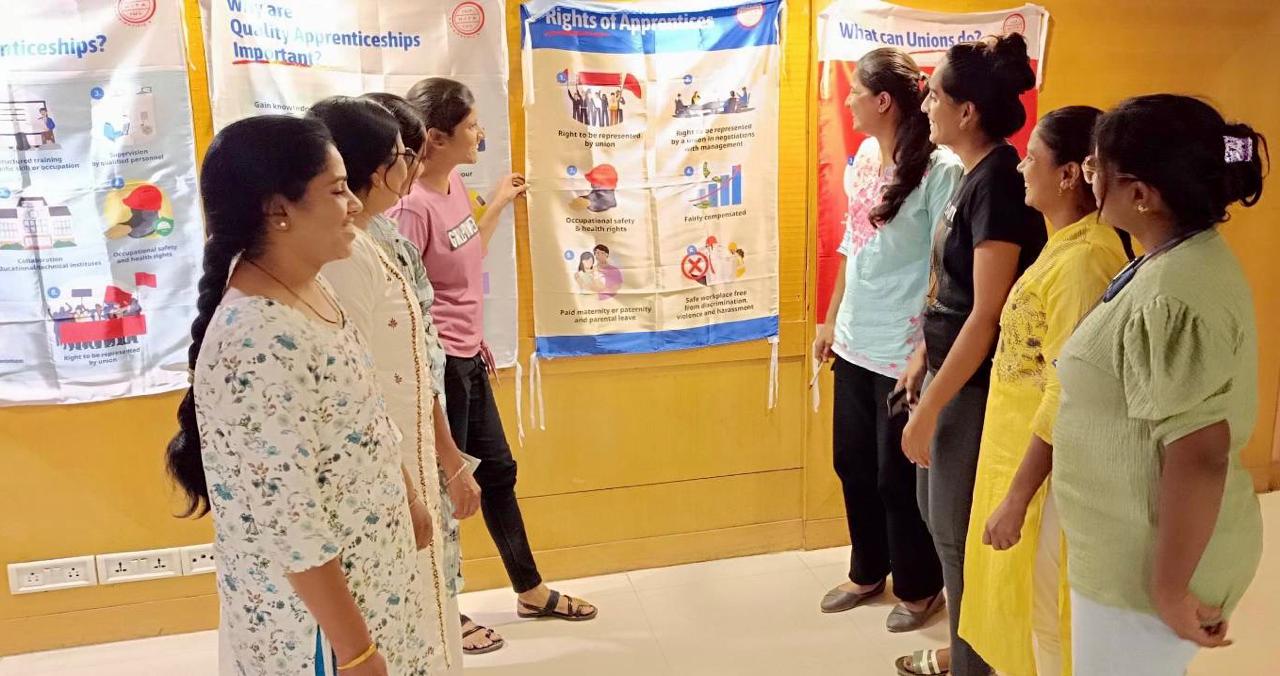
On August 10, 2024, IUF Asia/Pacific organized training with apprentices in India on ILO Recommendation 208 on quality apprenticeships as a way for youth, especially for young women to get skilled jobs, secure employment & better wage and to secure rights of apprentices as defined in the r. 208. Apprentices have the right to seek union representations in case their rights are violated and unions have the right to intervene to ensure fair treatment and protect rights of apprentices.
On August 25, 2024, IUF Asia Pacific Thailand organized workshop on “Quality Apprenticeship” for three Food and Beverage Unions in Thailand. The workshop aimed to empower union leaders and young members by promoting quality apprenticeships. It stressed the need for reskilling, upskilling, and green skills to enhance employability. In a group activity, unions identified apprenticeship opportunities, outlined training program possibilities, and emphasized the need for certified training from management.
On August 24, 2024, the newly formed IUF – Pakistan Coordinating Council organized youth leadership training in Lahore to build understanding on quality apprenticeships, automation, and green skills. The group recognized that quality apprenticeships offer a valuable opportunity for the young workers to acquire skill and upskill. Additionally, the training covered the importance of green skills in increasing employability for young workers. In group work sessions, participants delved into workplace skill mapping, identifying potential apprenticeship opportunities at their respective workplaces and through the unions, negotiate it with the management.
On August 19-20, 2024, IUF affiliated FSBMM, food & beverage unions’ federation in Indonesia organized youth leadership meeting where youth discussed the International Youth Day theme – Youth, Jobs, Justice, what it means for them and the importance of receiving certified training and acquiring skills. It can happen through strong unions.
On August 12, 2024 Hotel and Tourism workers unions in Nepal, NIHWU & UNITRAV training for youth leaders and called for skilled jobs for youth with rights.

International Youth Day banner translated in Bengali, Hindi, Indonesian Bahasa, Sinhala, Thai and Urdu.

by IUF Asia/Pacific | Jul 12, 2024 | Hotel & Tourism Sector, Our Union Our Power
The IUF-affiliated Pakistan Hotel, Restaurants, Club, Tourism, Catering and Allied Workers’ Federation [PHRCTCAWF] with the support of IUF Asia/Pacific launched the initiative to organize workers in small hotels, restaurants, and bakeries in Pakistan who are largely unorganized.
The organizing initiative is part of the 14th IUF Asia/Pacific Regional Conference Decisions to build collective bargaining power to ensure secure jobs, safe work, and better wages throughout the hotel & tourism [H&T] sector, including small and medium hotels and tourism operations.
 The organizing started in Swat Valley in Khyber Pakhtunkhwa Province, one of the major tourist destinations in Pakistan. The region has a large number of small hotels employing a substantial workforce in hotels and in tourism. However, the workers are not recognized as workers, not registered with any government agency and as such have no legal protections.
In 2023, the Serena Hotel Employees Union in Swat Valley, Khyber Pakhtunkhwa Province, created the Small Hotels Workers Action Committee to mobilize workers in several small hotels to campaign for the implementation of the legal minimum wage and mandatory social insurance.
Small hotels generally employ 15 to 20 workers in precarious employment arrangements, with high workloads and often unsafe working conditions. Workers are required to work for 12 to 14 hours in poverty wages.
After the successful organizing of the Action Committee, in February 2024, the Small Hotels Workers Association was formed and applied for affiliation to PHRCTCAWF.

Small hotels Workers attending an educational meeting to discuss the impact of the climate crisis on tourism and their employment.
As a result, workers in Peshawar, in the same Province, approached the Small Hotels Workers Association and started organizing small hotels and bakery workers in Peshawar.

by iufasiapacific | Jul 5, 2024 | Collective Bargaining Rights, Our Members, Our Union Our Power, Secure Jobs
Members of the IUF-affiliated National Workers Union (NUW) in Fiji won a historic 10-day strike at the site of Natural Waters of Viti Limited (NWVL), which produces the Fiji Water brand exported around the world.
Despite the tremendous patience of members and the efforts of NUW to reach an agreement with NWVL management earlier this year, talks broke down on April 8, 2024. This forced members to take industrial action – the first strike in decades in Fiji – to defend their rights and interests.
When negotiations broke down, management was still refusing to introduce basic benefits such as a shift allowance, Cost of living allowance (COLA) and would not make transport arrangements for workers required to overtime. The factory is in a very remote location – at the very source of the famous Fiji Water brand.

Job security was a critical issue in the negotiations. With so many changes to job roles due to automation and plant expansion, the union was seeking a job review. Management refused. In addition, management had started to deploy casual workers employed under precarious employment arrangements to carry out regular job roles. This violated the collective agreement and undermined the job security of union members.
Union members went on strike on on May 7, 2024, at the water bottling plant in Yaqara and the Naikabula depot in Lautoka on the main island Viti Levu. After a determined strike that mobilized all union members, an agreement was finally reached on May 16, granting all of the union’s demands.
NWVL is owned by The Wonderful Company in the US and Fiji Water is the leading premium bottled water in the US market.

During his visit to Fiji, the IUF Asia/Pacific Regional Secretary congratulated Brother Felix Anthony, the NUW General Secretary, on the historic win.


by IUF Asia/Pacific | Jun 29, 2024 | Collective Bargaining Rights, Freedom of Association, Hotel & Tourism Sector, Our Union Our Power, Right to a Safe Workplace
Hotels are as much as about the service that workers provide as the location and facilities. Rooms and facilities are cleaned and maintained, food is prepared, cooked and served. Guests are attended to, entertained, assisted, and kept safe. From the laundry to food and beverage, to cafes, restaurants, conference rooms and banquet halls, there is cleaning, maintenance, preparation, security and constant service.
Yet for most international hotel chains, workers are invisible, an afterthought, or just an expense. Based on the attitude of an entire generation of HR managers who lack any understanding of industrial relations and work, workers are just a problem to be solved.
Without workers nothing works. Nothing happens. No one eats. Nothing gets cleaned. Without the service, security and welcome atmosphere that guests pay for, the hotel is just a building. In fact it is the service provided by hotel workers that makes the people that come to hotels guests. Ignoring this reality, international hotel chains spend hundreds of millions of dollars on loyalty programs, brand promotion, and image. This entire business model fails to take into account that loyalty is based on a good experiences and that experiences depend on hotel workers.
The hundreds of millions of dollars wasted on loyalty programs and brand promotion should be redirected to paying workers decent wages; improving working conditions; guaranteeing safe, secure (permanent) jobs; protecting hotel workers from harassment and abuse; reducing excessive workloads and reducing workplace stress; and ensuring that workers can freely access their rights, including the right to join a union and the right to a safe workplace. These are human rights.
Similarly, all of the financial resources redirected to brand image is ultimately wasted if global hotel chains allow local management to treat workers unfairly; engage in discrimination; impose excessive workloads; bully, intimidate and harass; and blame workers’ “attitude” on anything and everything that goes wrong. This happens because there is no recognition of the value of the work of hotel workers in all their different job roles and occupations. There is no recognition of hotel workers’ valuable contribution to the hotel as a business and its brand. Since their value is not recognized, workers are not respected. When managers and supervisors do not respect workers it opens the door to all sorts of abuse and unfair treatment.
The failure of corporate management to stop this abuse and unfair treatment gives these abusive managers and supervisors a sense of impunity. Managers are emboldened by this sense of impunity, and it just gets worse for workers.
The tragic result is that the people expected to provide warm, friendly, prompt, efficient, professional service and/or to work hard, meet targets and follow (constantly changing schedules), simply cannot. When some workers give up and leave, management blames workers’ lack of loyalty or the problem of retention (“they keep changing jobs”). The hotel industry then goes running to government and the media complaining about a “labour shortage”. What they don’t explain is that there is only a shortage of workers willing to work under these abusive conditions – underpaid, overworked, and denied dignity and respect. Well, yes – there is a shortage of that kind of labour because most workers are aware of their human rights and won’t tolerate these abusive conditions.
The solution for these global hotel chains, it seems, is to bring in workers who are not aware of their rights or who are too vulnerable and afraid to exercise their rights: migrant workers on temporary visas, newly arrived immigrant workers or refugees, undocumented workers, or students. (Exploiting students under the guise of “on the job training” is rampant in the international hotel chains in many countries.)
The entire management approach of international hotel chains seems to hinge on the hope that hotel guests don’t see workers as people (and for certain workers like housekeepers, cleaners and kitchen hands to never see them at all). Yet everyone has a name tag with their first name (or if their real name is a difficult “ethnic” name, then they will be Peter, Mike or Jenny). Hotel workers who have contact with guests have to introduce themselves by name. All very personal, all very human. But what workers cannot be is an actual person with a family to get back to, bills to pay, family events to attend, or anything else that might suggest that beyond the name tag is a real person with a life of their own.)
Hotel workers are expected to bring the warmth and friendliness and smile of a person, but not expected to be treated as a person. Hotel workers are expected to be professional, but are not treated as professionals with ability, skills and experience. They certainly are not paid according to their skills, ability and experience. Hotel workers are not paid for their valuable contribution and the important work they do. Because the value of their work and contribution is not recognized.
Ultimately this recognition can only come through joining or forming a union, combining together to exercise the collective bargaining power needed to stop the unfair treatment and abusive practices in hotels. It is the collective bargaining power needed to ensure safe, secure jobs free from anxiety and stress. It is the collective representation through the union needed to end the impunity of abusive managers and supervisors, and to eliminate discrimination, bullying and sexual harassment in the workplace. It is the only way to work with dignity and respect. It is the only way to ensure recognition of the value of the work of all workers in a hotel or resort.
Joining or forming a union is not a magic solution for hotel workers. It requires continuous organizing and constant bargaining. It involves a never ending fight to be treated decently, and paid fairly. It involves constant reminders to management to treat workers (union members) with respect. But it is the only way to bring about these changes. Because the only thing that matters to the international hotel chains is the value of their very expensive, very fragile brands. We need to get organized to remind them that behind that brand is hotel workers, and hotel workers have value.

Hotel housekeeping workers in the Philippines protest “room quotas kill!” on International Workers Memorial Day, 28 April

by IUF Asia/Pacific | Jun 25, 2024 | Campaigns, Environment, Our Union Our Power
On June 12, the IUF-affiliated Bodu Kanneli Masveringe Union [BKMU], the Yellowfin Tuna Fishers Union organized a landmark protest demanding fair price for tuna catch and calling on the government to stop licensing longline fishing. 38 tuna boats with more than 570 fishers joined at the sea to exercise their right to freedom of association and collective bargaining.
As the protest grew and more boats joined, the Minister of Fisheries and Ocean Resources of Maldives had to come to the coast to address the protesting fishers and to start negotiation on the demands of BKMU members. After negotiations, the government agreed to stop licensing of longline fishing until effective consultation with the union. Furthermore, the government agreed to reduce fuel cost immediately and started negotiation on fixing fair price for tuna catch.
BKMU members engage in handline fishing of yellowfin tuna to ensure sustainable catch, avoiding over-fishing and preserving the ocean ecosystem. However the government proposed introducing commercial longline fishing licenses, a move that would benefit large tuna companies but threaten the ocean ecosystem and livelihoods of fishers.
“Stop discussions to start longline fishing and I urge government to fulfill the promises to fisherman’s as it is in their manifesto” Hussain Nasheed, BKMU President

by IUF Asia/Pacific | Jun 13, 2024 | Food Service Workers, Our Union Our Power, Youth in Unions
In accordance with the 14th IUF Asia/Pacific Regional Conference’s Decision No.15 “Organizing Power in the Food Services Sector”, IUF Asia/Pacific is committed to build union strength in restaurants, fast food, coffee shops, catering, and food delivery services and campaigning for better wages and conditions that recognize the value of the work of Food Services workers.
As part of the initiative, IUF Asia/Pacific supports the self-organized Chiang Mai Barista Union in Thailand. In May 2024, the newly formed Chiang Mai Barista Union, organized their first ever International Workers’ Day rally to raise their collective demands of better wages and working conditions. Messages like “Fair wages for fair work” and “Minimum wage, not minimum standards” resonated with the public as well.

IUF Asis-Pacific supported the young workers in amplifying their demands. Access to simple resources, such as placards, paint, and brushes, proved vital, empowering the young baristas to express their perspectives on workers’ rights through impactful signage.
Furthermore, the Barista Union collaborated with the Northern Labor Network and other civil society organizations. Together, they submitted a petition to Chiang Mai’s Mayor and Provincial Governor advocating for an increase in the minimum wage. They collectively marched through the city’s historic old town, culminating at Tha Phrae Gate for a public demonstration.

Around 200 workers, mostly young workers, marched through the city of Chiang Mai in a landmark rally of food services workers.
Doi, a founding member of the Barista Union, delivered a speech on behalf of the Northern Labor Network. His message underscores the potential of unions to empower young workers and improve working conditions within Chiang Mai’s service industry.

Doi addressing the rally and speaking on importance of unionizing
Moreover, Doi specifically acknowledged the crucial support provided by IUF Asia Pacific. This assistance facilitated the union’s first large-scale member mobilization, solidifying its organizational structure.
This is a significant step by the youth to build union strength and to ensure that food service jobs are good, safe jobs that provide decent incomes for workers and their families now and in the future.