by IUF Asia/Pacific | Jun 25, 2023 | Campaigns, Climate Justice, Human Rights, Social Justice
On June 15, 2023, the 28th IUF Congress in Geneva adopted a historic Resolution No. 24 on Fighting for the future of Indigenous and First Nation peoples. The resolution calls for unions to support recognition of the rights of indigenous and First Nation peoples including the restoration of their lands and heritage and the recovery of their language and traditional knowledge. It also calls for protecting and advancing the rights, interests and livelihoods of the indigenous and First Nation workers, farmers and fisherfolk and their communities and ensuring they are included in all aspects of just transitions and climate justice.
Sister Paulomee Mistry, General Secretary of Gujarat Agriculture Labour Union, moved the resolution by highlighting displacement of indigenous peoples from their land, destruction of their livelihood, forced migration and drawing attention to indigenous peoples deep-rooted cultural and traditional ties to nature and symbiotic relationship with forests.
Calling for fight for the future of Indigenous and First Nation peoples:

Paulomee Mistry, General Secretary of Gujarat Agriculture Labour Union addresses the 28th IUF Congress
In the late 1950s roughly 30,000 families were displaced due to the construction of the Rihand dam in the Singrauli region of Central India. Many of them belonged to the Baiga Community, a particularly vulnerable Indigenous group in India. Hardly 20 years later, they would find themselves uprooted again to make way for a super thermal power project. Yet again, a few years later they were forced to move to make way for industry; and then again, a fourth time for more industrial development.
This is the story of India’s indigenous population, the Adivasis or First Inhabitants of the land – regularly displaced and exploited and pushed further into the web of multidimensional poverty in the name of development.
India is a home to the second largest Indigenous population in the world with a population of 104 million and about 702 Indigenous community. The indigenous communities of India are known for their distinct dialect, deep-rooted cultural, and traditions, such as worship nature, and symbiotic relationship with the forests. They had their autonomous sovereign framework prior to the colonial intervention.
Over time they have been alienated from their land with the imposition of unfair land ownership laws and the principle of eminent domain. In addition, there is an ongoing covert attempt to further alienate them from their legacy and rights as first settlers by using a newly coined phrase – “vanvasi” in place of “Adivasi” or First Dwellers. As a result, today, five out of six multidimensional poor people are from Indigenous communities in India.
About 93% of India’s Indigenous people live in rural area, dependent on subsistence agriculture. In addition, they also depend on collection and processing of forest produce and daily-wage labour to survive. There are problems in all three areas: Agriculture is affected by small land holding, poor soil quality, lack of irrigation, low productivity and climate change.
Further, because rights of ownership to Indigenous land in India generally do not exit, Indigenous cultivators, farming on land to which they have no legal title are subject to regular fines, harassment and exploitation by the forest department.
Mega developmental projects like industries, mining, dams, wild life sanctuaries, parks and conservation of nature, etc. have displaced and uprooted millions of indigenous people from their forest. Between 1951 to 1990, more than 8.5 million Indigenous peoples were displaced. Less than a quarter of them were rehabilitated.
Many Indigenous peoples have thus been pushed to seek and supplement their livelihood through wage labour. As per the estimates of the Ministry of Indigenous Welfare, between 2001 and 2011 alone, 3.5 million Indigenous left agriculture to join the informal labour market. Current estimates suggest that one in every five unorganized sector workers in India is Indigenous.
Therefore, I request all brothers and sisters to support the Resolution No. 24 on fighting for the future of indigenous and First Nation peoples

by IUF Asia/Pacific | Jun 23, 2023 | Campaigns, Peace
On June 16, 2023, the 28th IUF Congress in Geneva adopted a the historic Resolution No.23 on Peace and Nuclear Disarmament. The resolution was proposed by Food Rengo, UA ZENSEN, Service Tourism Rengo and Noh-Dan-Roh.
Brother Toshiyuki Ito, President of Food Rengo, moved the resolution with the following speech, describing the horrors of Japan’s experience of the use of nuclear weapons and called for nuclear disarmament to prevent the tragedy of Hiroshima and Nagasaki from ever happening again.
Calling for peace and nuclear disarmament

Brother Toshiyuki Ito, President of Food Rengo, addresses the 28th IUF Congress
I would like to express my opinion in favor of this resolution.
78 years ago, atomic bombs were dropped on Hiroshima and Nagasaki, claiming the precious lives of approximately 140,000 people in Hiroshima and 74,000 people in Nagasaki.
When the atomic bombs exploded, high heat was generated and it created a “mushroom cloud”. The rain that fell at that time is called “black rain”. This highly radioactive “black rain” caused secondary exposure to radiation, including hair loss and hemorrhaging. The rain was also dispersed by the wind, causing serious damage extensively.
Until now, many atomic bomb survivors suffer from leukemia, cancer, and other radiation-related diseases that affect future generations.
As the only country to have experienced the atomic bombings, we, Japanese labor unions, strongly believe that such a tragedy must never be repeated. Therefore, every year, RENGO, the national center, and Food Rengo, the industrial federation, hold peace actions and education in Hiroshima and Nagasaki.
The purpose of this event is to listen to the stories of the people who know what it was like to live in those days and to learn the fear of nuclear weapons and, at the same time, to learn the preciousness of peace.
Those who knew those days became old and are decreasing every year. It is precisely because of this situation that we must not let the events of 78 years ago fade away, but must pass them on to the next generation.
We have also been involved in actions such as “10 Million Signatures for Nuclear Weapons Abolition” together with the National Center and other related organizations toward the “Nuclear Non-proliferation Treaty (NPT) Review Conference”.
We will continue to appeal widely to the international community about the tragic experience of the atomic bombings caused by nuclear weapons and promote efforts for the “abolition of nuclear weapons”.
Finally, I would like to say to Congress, “No more Hiroshima, no more Nagasaki! No more!”

by IUF Asia/Pacific | Jun 23, 2023 | Campaigns, Defending Democracy
On June 16, 2023, the 28th IUF Congress in Geneva adopted a vital Resolution No.1 on Restoring democracy and defending human rights in Myanmar. The resolution was proposed by Food Rengo, UA ZENSEN, Service Tourism Rengo, Noh-Dan-Roh and UFCW North America.
Brother Hiromu Kogure, Vice President of UA ZENSEN, moved the resolution with the following speech, calling for greater action to ensure transnational companies cease their operations and divest from Myanmar. This is vital to ending all direct or indirect collaboration with the military junta and ensuring the restoration of democracy and democratic rights in Myanmar.
Continued support for Myanmar and pressure on transnational companies to “responsibly withdraw” from Myanmar!

Brother Hiromu Kogure, Vice President of UA ZENSEN, addresses the 28th IUF Congress
Two years have passed since the military coup in Myanmar. The situation shows no signs of getting any better, with innocent civilians, democracy activists, and union activists being killed, their homes burned, and the tragic situation continues.
First of all, I would like to express my deepest respect to Regional Secretary Brother Hidayat for his dedicated support to our affiliated unions in Myanmar to date.
UA ZENSEN has so far provided emergency assistance to CTUM on three occasions and will continue to do so until the day when democracy is achieved in Myanmar and union activists can work in peace.
The world tends to focus on Ukraine, but we also request continued and stronger support for Myanmar.
I am also aware that the IUF is working vigorously, led by Regional Secretary Brother Hidayat, on the “responsible withdrawal” from Myanmar that many GUFs are pursuing.
Several global beverage and food companies have established and are still operating in Myanmar.
Some say that asking these companies to withdraw would “take away the jobs of their members,” but in Myanmar, trade unions that are democratic in their activities are suppressed, while so-called “yellow unions” that are obedient to the military regime are more common. We also hear that many jobs for union members are being replaced by so-called non-unionized, non-regular workers.
It is no longer possible to practice human rights due diligence in Myanmar, and I will conclude my remarks by asking the IUF to increase pressure on transnational companies operating in Myanmar.

by IUF Asia/Pacific | Jun 11, 2023 | Campaigns, child labour
On the International Day for the Elimination of Child Labour, June 12, 2023, union members across the Asia-Pacific region demand action to stop child labour, and to turn the situation around for 160 million children around the world.
Ending child labour means freeing children from fear, injury and exploitation and ensuring their education, health and wellbeing. The right to education, health and wellbeing is a universal human right and child rights. These rights are fundamental to ensuring that all children, everywhere, live a full a meaningful life worthy of human dignity.
This reiterates calls by unions in the IUF Asia/Pacific Region last year to end the exploitation of child labour in food supply chains.
Taking action to stop child labour includes tackling key drivers of child labour in agriculture (piece-rate wages, unfair crop prices, debt) and recognition that the climate crisis has a huge impact on child labour, especially in agriculture.
Union members across the Asia-Pacific demand that we stop child labour and turn the situation around for over 160 million children around the world. [The following are gif images] Please visit us on Twitter , Instagram and Facebook to see more photos.

by IUF Asia/Pacific | May 23, 2023 | Bahasa Indonesia, Campaigns, Secure Jobs, Sustainable Tourism
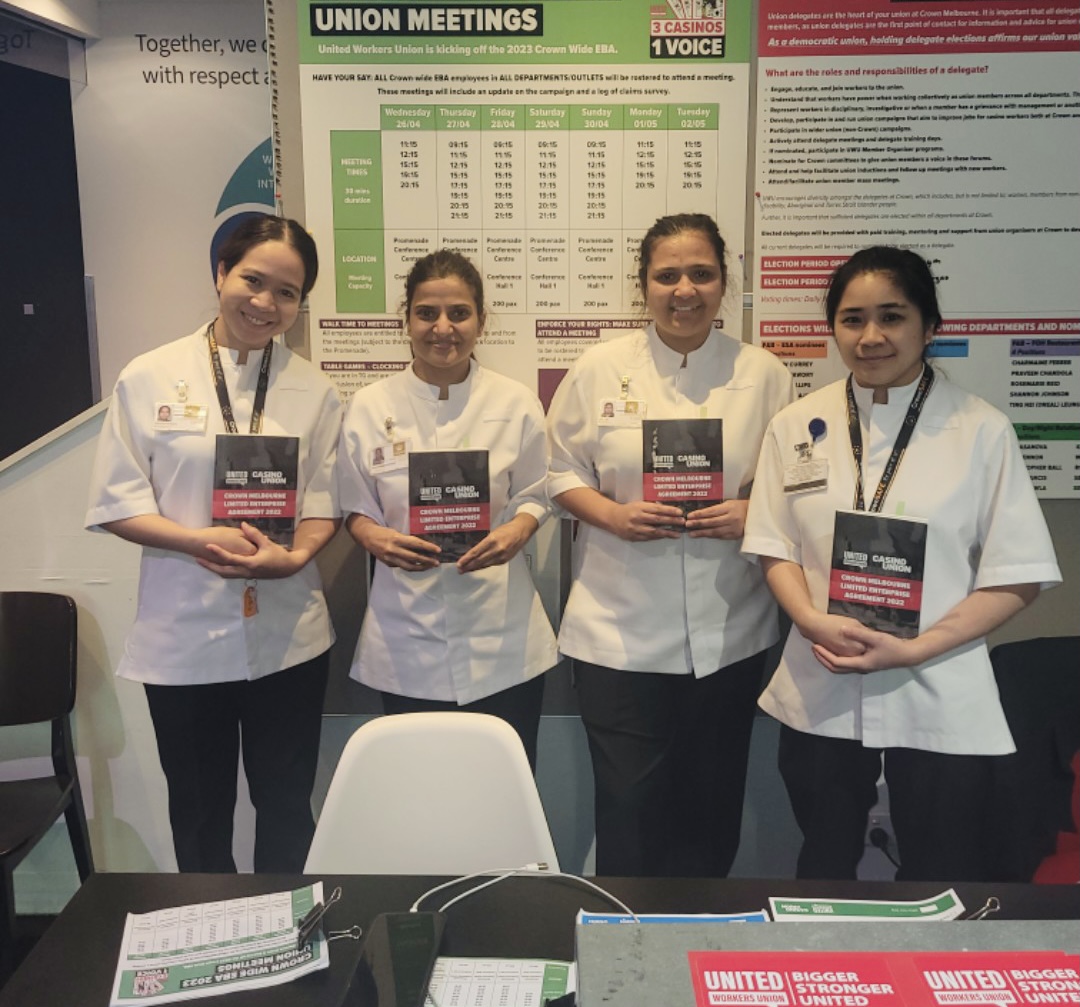
 Dalam kemenangan besar bagi para housekeeper yang sebelumnya dipekerjakan melalui kontraktor/agen tenaga kerja, 700 housekeeper akan menjadi pekerja tetap yang dipekerjakan langsung di hotel dan kasino Crown Resorts di Melbourne, Australia. Sebagai hasil dari komitmen kampanye, pengorganisiran dan perundingan yang dilakukan oleh United Workers Union (UWU), mereka sekarang akan menikmati upah dan jam kerja yang lebih baik, hak cuti yang lebih baik, dan keamanan kerja yang lebih baik.
Berita kemenangan ini disambut baik oleh serikat hotel dan resor di seluruh wilayah Asia-Pasifik sebagai kemenangan bagi seluruh pekerja yang berjuang untuk mendapatkan pekerjaan yang aman..
Sebagai bagian dari Global Housekeeping Campaign (GHC), serikat pekerja di Asia Tenggara mengungkap kondisi kerja yang kejam, jam kerja yang berlebihan, dan risiko kesehatan yang dihadapi oleh para housekeeper outsource, lepas dan kontrak.
Secara khusus, Global Housekeeping Campaign di Filipina menuntut agar seluruh housekeeper dijadikan permanen dan kuota kamar – sumber utama beban kerja dan cedera yang berlebihan – dihapuskan.
 Ketika kami mendengar tentang kemenangan UWU di Crown Resorts, kami segera memberi tahu anggota kami di NUWHRAIN dan ratusan housekeeper yang tergabung dalam GHC Filipina. Ini juga merupakan dorongan besar bagi mereka dan akan merevitalisasi kampanye kami. Geoffrey Labudahon, SENTRO’s coordinator of GHC Philippines.

Kami selalu menuntut agar housekeeper adalah pekerja langsung, permanen, dan bukan outsourcing. Dalam pandemi, semua orang melihat bahwa housekeeper adalah pekerja penting dan mereka berhak mendapatkan gaji yang lebih baik serta pekerjaan yang aman dan terjamin. Sangat senang melihat kemenangan UWU di Crown Melbourne memperkuat pesan ini. Galih Tri Panjalu, General Secretary of FSPM in Indonesia.
 Housekeeper memainkan peran yang sangat penting di resor kasino. Mereka adalah bagian penting dari tenaga kerja utama kasino dan pekerjaan mereka sangat penting. Lebih banyak serikat pekerja perlu mengikuti contoh UWU dalam memenangkan pekerjaan tetap untuk para housekeeper. Ben Lawrence, Secretary of GMBWU at Resorts World Casino in Genting, Malaysia.
Anggota resor hotel dan kasino dari Filipina, Indonesia, Malaysia, dan Thailand mengirimkan ucapan selamat dan solidaritas, menyatakan “kalian menginspirasi kami!”
by IUF Asia/Pacific | May 17, 2023 | Campaigns, Secure Jobs, Sustainable Tourism
In a huge win for housekeepers formerly hired through a labour contractor/agency, 700 housekeepers will become direct, permanent workers at Crown Resorts’ hotels and casino in Melbourne, Australia. As a result of the committed campaigning, organizing and bargaining of the United Workers Union (UWU), they will now enjoy better wages and working hours, improved leave entitlements, and more job security.
News of the win was welcomed by hotel and resorts unions around the Asia-Pacific region as a win for all workers fighting for secure jobs.
As part of the Global Housekeeping Campaign (GHC), unions in Southeast Asia exposed the abusive working conditions, excessive hours, and health risks faced by outsourced, casual and contractual housekeepers.
In particular the Global Housekeeping Campaign in the Philippines demanded that all housekeepers be made permanent and that room quotas – a major source of excessive workloads and injuries – be abolished.
 When we heard about UWU’s win at Crown Resorts we immediately informed our members in NUWHRAIN and the hundreds of housekeepers that are part of GHC Philippines. This is a great boost for them too and will revitalize our campaign.
Geoffrey Labudahon, SENTRO’s coordinator of GHC Philippines

We’ve always demanded that housekeepers are direct, permanent workers and not outsourced. In the pandemic everyone saw that housekeepers are essential workers and they deserve better pay and safe, secure work. It’s great to see the UWU’s win at Crown Melbourne reinforce this message.
Galih Galih Tri Panjalu, General Secretary of FSPM in Indonesia
Housekeepers play a very important role in casino resorts. They are a key part of the main workforce of the casino and their work is essential. More unions need to follow the example of UWU in winning permanent jobs for housekeepers.
Ben Lawrence, Secretary of GMBWU at Resorts World Casino in Genting, Malaysia
Hotel and casino resorts members from the Philippines, Indonesia, Malaysia and Thailand sent their congratulations and solidarity, declaring “you inspire us!”