In order to bring back and revive the IUF Global Housekeeping Campaign initiative in Indonesia, the Federation of Hotel, Restaurant, Plaza, Apartment, Catering and Tourism Workers’ Independent Union (FSPM) organized series of event in Yogyakarta and Labuan Bajo, to raise awareness of the valuable work carried out by room attendants.
On November 21-22, the FSPM introduce its first campaign in Yogyakarta. They coordinated a joint exhibition at a university to educate general public about the hard and skilled work performed by room attendants every day. While sharing information on the health risks faced by room attendants, people who passed FSPM booth were invited to make a bed themselves, and the time they took to complete the task was recorded. Students and passerby gave testimonials, acknowledging that the work of room attendant is not easy, especially when they are rushed to meet room quota expectation.
Awareness raising with passerby
In Labuan Bajo, one of Indonesia’s main tourism destinations, FSPM launched a campaign initiative on November 22 by organizing a competition for hotel workers and tourism students, as the future workforce of hospitality industry. FSPM conveyed a message that room quota targets put the health and safety of room attendants at risk. Drawing in experiences from previous initiatives carried out by IUF affiliates worldwide, experienced room attendant who participated in the competition, as well as school teachers, affirmed that more respect and dignity toward housekeepers should be shown to appreciate their work. It was emphasized that Labuan Bajo, as super-premium tourist destination, should also provide super-premium working condition for its workers.
Organizing hotel workers in key tourist destination is crucial to ensure that tourism development benefits not only visitors, but also local communities and its workers. Clean, comfortable rooms are at the heart of hospitality business, in which room attendants are playing a vital role in providing excellent experience for guests.
FSPM calls for improved working conditions, including fair employment contracts, end of wage theft and elimination or reduction of room quotas. By recognizing the valuable work of room attendants, the hospitality industry can promote a safer and just tourism for all.
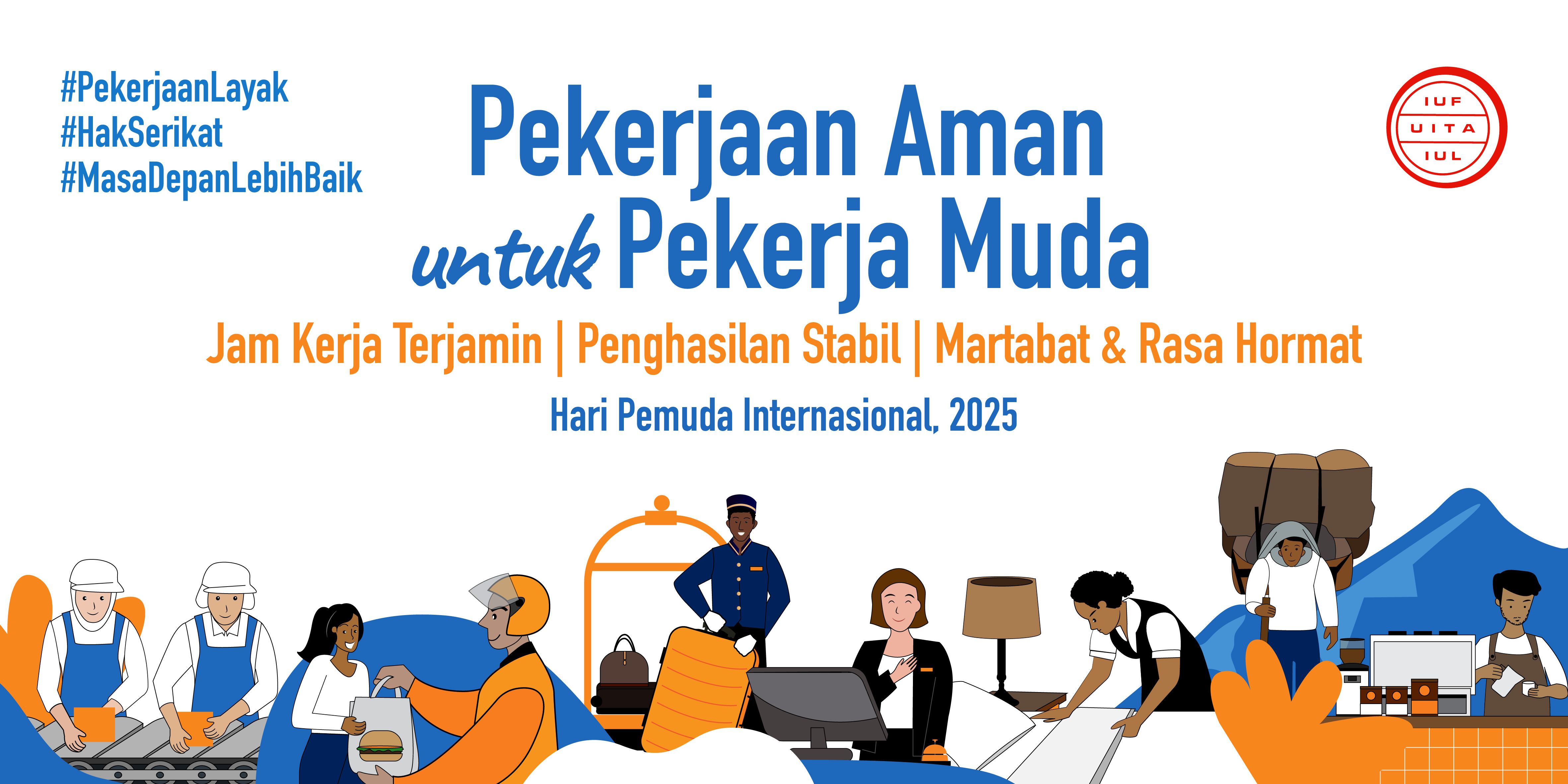
On International Youth Day 2025, young workers across food systems are demanding secure, permanent jobs that provide stability, dignity, and a future they can count on. They are pushing back against a system that too often relies on insecurity.
Many of the new positions being created for young workers are contract-based, part-time, casual, or zero-hour contracts, offering little to no job security, unpredictable schedules, and poverty wages. For young workers entering the workforce, this means constant uncertainty: not knowing how long they will have work, how many hours they will get each week, or whether they can pay rent, cover transport, or afford basic living costs.
Precarious employment not only creates stress and strips young workers of the ability to plan for their future, but also undermines their rights. It weakens their ability to exercise their enabling rights, including freedom of association and collective bargaining.
In the food processing and beverage manufacturing sector, most young workers are employed in contract or outsourced jobs. In the hotel industry, in addition to the precarious employment, young workers are often exploited through prolonged traineeships and internships.
While the food services sector continues to grow rapidly, so does the number of precarious jobs. Employers across fast food, cafés, and food delivery platforms often promote “flexible working” to attract young workers, but too many remain trapped in casual, low-paid roles that bring constant stress and no certainty. This so-called “flexibility” is often just a way to cut labour costs, leaving young workers to bear all the risk and insecurity.
Young workers are calling for secure jobs with guaranteed hours, stable incomes, and respect and dignity at work. They are organizing in unions and demanding real change.
Through union power and collective action, young workers are fighting back. They are winning permanent contracts, challenging wage theft, building strength in their workplaces, and securing the ability to plan their lives, support their families, and work with dignity.
Chiang Mai Barista Labour Union members winning against wage theft!
Barista workers in Chiang Mai, Thailand, through the Chiang Mai Barista Labor Union, won against wage theft in the form of recovered wages of two months of unpaid wages, and secured compensation for wages that had been paid below the legal standard over the past year. On March 19, 2025, the Chiang Mai Provincial Office of Labor Welfare and Protection ordered the employer to pay the full amount of compensation claimed.
National Food Delivery Riders Union [NFDRU] members in the Philippines wining against wage theft!
On July 30, 2025, NFDRU recovered lost wages for 20 food delivery riders. Through the unions, Foodpanda Philippines was finally forced to enforce an National Labor Relations Commission’s decision ordering the company to fairly compensate riders.
Also in Indonesia, listen to the voices of union members at PT. Indolakto Purwosari, part of the FSBMM, who have secured permanent jobs through their union’s strength and determination.
Independent Union Workers of Coca-Cola Indonesia (SBCCSI) held a seminar on “Maintaining Job Security” on May 24-25, 2025 in Cisarua, Bogor, Indonesia in response to workers’ concerns about threats to job security. In this seminar, job security was defined comprehensively to include guarantees of job continuity, protection against structural changes in the company, certainty of workers rights, and guarantees of occupational safety and health. Participants identified various concrete threats such as automation processes that replace human labor, company restructuring, outsourcing practices, and regulatory changes that can have a negative impact on workers. In facing these challenges, SBCCSI share a multidimensional strategy to protect workers from unsecure job by collective approach through trade unions, increasing worker competence, and strengthening negotiation skills with management. This seminar also became an arena to convey workers’ expectations to companies to be more transparent in policy changes, involve trade unions in decision-making, provide skills improvement programs, and maintain workers’ rights even in restructuring situations. The continuity of dialogue between workers, trade unions, and companies is seen as the key to creating a stable and equitable work environment amidst the ever-changing dynamics of the industry.
SBCCSI President Dwi Haryoto provided material on understanding job security, layoffs and restructuring.
Serikat Pekerja Independen Coca-Cola Indonesia (SBCCSI) menyelenggarakan seminar tentang “Menjaga Keamanan Pekerjaan” pada 24-25 Mei 2025 di Cisarua, Bogor, Indonesia sebagai respons atas kekhawatiran pekerja tentang ancaman terhadap keamanan kerja. Dalam seminar ini, keamanan kerja didefinisikan secara komprehensif yang mencakup jaminan kelangsungan kerja, perlindungan terhadap perubahan struktural di perusahaan, kepastian hak pekerja, dan jaminan keselamatan dan kesehatan kerja. Peserta mengidentifikasi berbagai ancaman konkret seperti proses otomasi yang menggantikan tenaga kerja manusia, restrukturisasi perusahaan, praktik outsourcing, dan perubahan regulasi yang dapat berdampak negatif terhadap pekerja. Dalam menghadapi tantangan tersebut, SBCCSI berbagi strategi multidimensi untuk melindungi pekerja dari pekerjaan yang tidak aman dengan pendekatan kolektif melalui serikat pekerja, meningkatkan kompetensi pekerja, dan memperkuat keterampilan negosiasi dengan manajemen. Seminar ini juga menjadi ajang untuk menyampaikan harapan pekerja kepada perusahaan agar lebih transparan dalam perubahan kebijakan, melibatkan serikat pekerja dalam pengambilan keputusan, menyediakan program peningkatan keterampilan, dan menjaga hak pekerja bahkan dalam situasi restrukturisasi. Keberlanjutan dialog antara pekerja, serikat pekerja, dan perusahaan dipandang sebagai kunci untuk menciptakan lingkungan kerja yang stabil dan adil di tengah dinamika industri yang terus berubah.
President SBCCSI Dwi Haryoto memberikan materi tentang pemahaman keamanan pekerjaan, PHK dan restrukturisasi.
Tangerang–Hundreds of workers who are members of the Food and Beverage Trade Union Federation (FSBMM) who came from Lampung, West Java, Jakarta, Banten, and Yogyakarta, held a second peaceful protest on May 5, 2025 in front of the Unilever Indonesia head office in BSD. This action was a response to the unilateral layoffs that were legally flawed, carried out by PT. Anugrah Mutu Bersama (PT.AMB) where this company is a Joint Venture company of Unilever that produces Bango Soy Sauce.
In their demands, the workers urged Unilever Indonesia management to reinstate Dani Afgani who is the General Secretary of FSBMM and a worker at PT.AMB and to stop the practice of union busting against workers who are active in union organizations. The action proceeded orderly with security guards, and the workers stated that they were ready to carry out further actions if their demands were not taken seriously.
Hundreds of workers united to demand the cancellation of PT. AMB’s unilateral layoffs which were legally flawed and the reinstatement of FSBMM Secretary General Dani Afgani